Am I an ambivert? 9 signs, and what the research actually says
Most people aren't introverts or extroverts. They land somewhere in the middle. Here's what being an ambivert really means, the signs that you are one, and why the middle is the most common place to be.
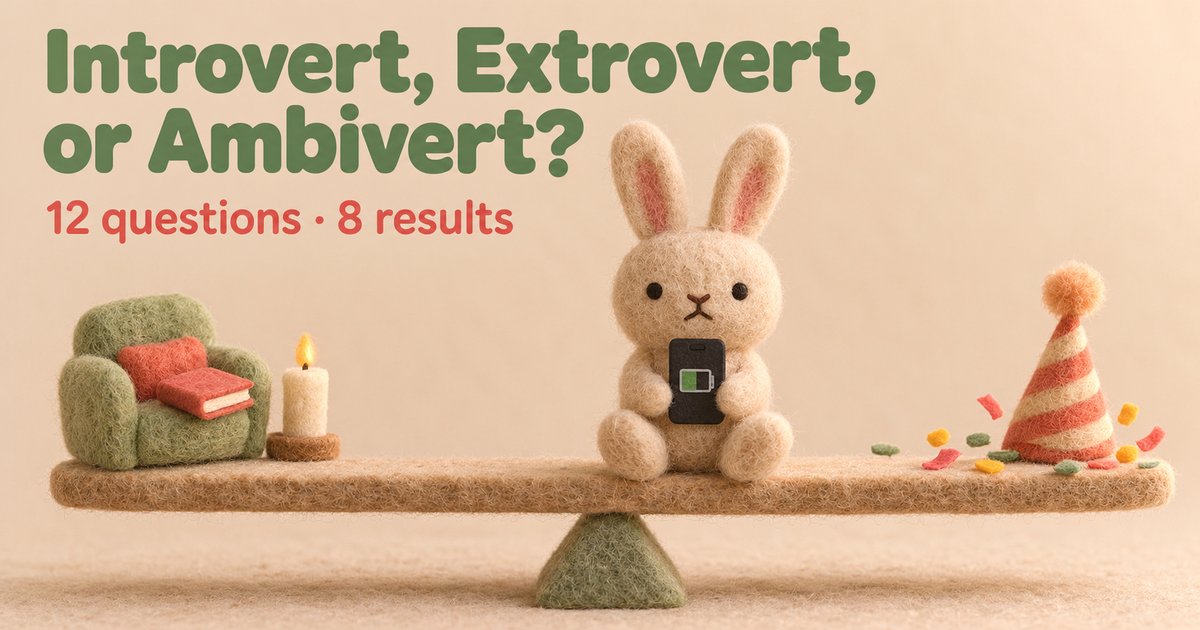
You love a good party, until suddenly you don't. You can talk to strangers for hours, and then need a full day alone with your phone on silent. Every introvert-or-extrovert quiz you take gives you a different answer.
That's not because you're broken or hard to read. You're probably an ambivert, and you're in good company. You may even be in the majority.
What an ambivert actually is
An ambivert is someone who sits near the middle of the introvert-extrovert line, not at either end. The word goes back to the 1920s, but it got popular again recently, once people noticed that "pick one" never fit them.
The key word is line. In the Big Five, the personality model most researchers actually use, extraversion is measured as a scale, not a category. You get a score, not a label. And like height, most people's scores bunch up in the middle. Far fewer people sit at the very ends.
That's the biggest difference from tests like the MBTI, which put everyone in one of two boxes, I or E. If you score 51% extrovert on a two-box test, you get called an extrovert, the same as someone at 95%. Retake it on a different day, and you might come out an introvert. That flip is itself a pretty good sign you live near the middle.
Introvert, extrovert, or ambivert: the quick version
| Introvert | Ambivert | Extrovert | |
|---|---|---|---|
| Recharges by | Time alone | Depends on the week | Time with people |
| At a party | Small talk drains fast | Fun for a while, then done | Gets more energy as it goes |
| First move | Usually waits | Depends on the room | Usually goes first |
| A weekend alone | Restful | Nice for a day, then restless | Feels like something's wrong |
| Typical friend group | Few and close | A mix of both | Big and spread out |
None of these are rules. They're tendencies, and most people can do all of them on the right day.
9 signs you might be an ambivert
- Quizzes keep giving you different answers. If you've been both an INFJ and an ENFJ, that's the middle of the scale talking.
- Your social battery has a timer. Two hours out feels great. Six hours feels like a marathon.
- Your mood decides the plan. The same Friday invite can sound amazing or exhausting, depending on your week.
- You're a slow warm-up, then hard to stop. The first hour you hang back, then it's 1 a.m. and you're still talking.
- You're good one on one and in a group. You can hold your own at a dinner party and on a long walk with one friend.
- People who meet you in different places disagree about you. Work friends say you're quiet. College friends say you never stop talking.
- You want plans, then want them canceled, then want them back. Annoying, but very common.
- You can be "on" when it counts. Interviews, first dates, and presentations go fine. You just need quiet afterward.
- Too much of either side wears on you. A week of nonstop plans is draining. A week totally alone is draining too.
If six or more of those sound like you, you probably live somewhere in the middle. If you want a clearer answer, our introvert, extrovert, or ambivert quiz checks three separate things: how you recharge, how fast you warm up, and how long you can go. It's free, and you won't need to sign up.
Shy is not the same as introverted
This trips a lot of people up. Shyness is about the first step: feeling nervous about starting a conversation or walking into a room. Introversion is about what refills you. They overlap, but they're different things.
That's why there are shy extroverts, people who get their energy from others but hate going first. There are also outgoing introverts, people who are great at parties and then silent in the car on the way home. Both are real, and both often end up calling themselves ambiverts, because neither label fits on its own.
It's also worth saying: being quiet or needing alone time doesn't mean something is wrong with you. Those are ordinary personality differences, not problems to fix.
Why being in the middle can be an advantage
A widely cited 2013 study, published in Psychological Science, looked at a few hundred call-center sales reps. The reps who scored in the middle of the extraversion scale brought in more revenue than both the strong introverts and the strong extroverts.
The researcher's explanation was flexibility. Ambiverts were outgoing enough to push for the sale, but also quiet enough to listen and not come on too strong. One study about one job doesn't prove ambiverts are better at everything. But it's a good reminder that the middle isn't a "neither." It's a range you can move around in.
What to do with this
Knowing where you sit is mostly useful for planning your week.
- Pace yourself. If your battery runs out after a few hours, schedule your plans with gaps instead of stacking a whole weekend.
- Pick an exit time. Leaving while you're still having fun beats staying until you're drained and grumpy.
- Say what you need. "I had a great time, I just need a quiet night" saves friends from wondering if they did something wrong.
- Don't apologize for the middle. You don't owe anyone a single label.
The fast way to find out
The 12-question introvert, extrovert, or ambivert quiz sorts you into one of eight results. There's the True Introvert and the True Extrovert at the ends, plus six middle types like the Social Battery, the Late Bloomer, and the Shy Extrovert. It takes about two minutes.