Are personality tests accurate? What they can and can't tell you
Most personality tests are measuring something real and reporting it with more confidence than it deserves. Here's what the research actually supports, why results feel uncannily specific, and how to read your own honestly.
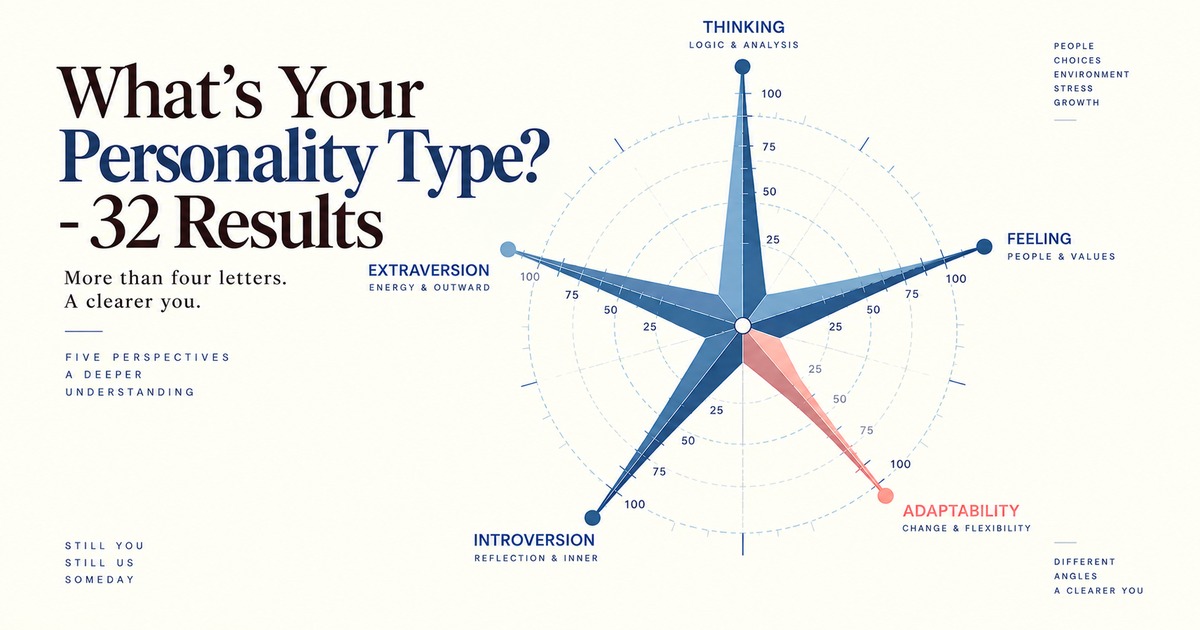
Every personality test you have ever taken sits somewhere on a line between "this is measuring something" and "this could be anyone." Knowing where a given test sits is more useful than knowing your result.
The part that holds up
Psychology has one personality model with broad research support: five traits that show up again and again across languages and cultures — openness, conscientiousness, extraversion, agreeableness, and emotional stability. They predict real outcomes at modest but genuine strength, and they're reasonably stable in adults, drifting slowly over decades rather than swinging week to week.
Everything else you've taken — including the four-letter tests, the color tests, the archetype tests — is either built on top of those traits, or built on nothing in particular. That doesn't automatically make it worthless. It does mean the confident paragraph about your future career prospects is not coming from where you think it is.
The two problems with type tests
Sorting into boxes throws away information. Most traits are distributed like height — most people are near the middle, few at the extremes. A test that calls you an "introvert" is drawing a line through the middle of a smooth curve. Someone one point on either side of that line gets a completely different label and a completely different description, despite being nearly identical.
The same person often gets a different result twice. If you sat near the middle on a dimension — which most people do on most dimensions — a bad night's sleep or a different mood is enough to flip you. If a test gives you a different answer in March than it gave you in January, the test isn't broken. It's showing you that you were never far from the line.
Why the results feel so accurate anyway
There's a well-documented effect here: people rate vague, broadly applicable descriptions as highly accurate about themselves specifically. You have a tendency to be critical of yourself. You have a great deal of unused capacity. Nearly everyone reads those and nods.
This is worth knowing not to make you cynical, but so you can tell the difference between a result that fits and a result that would fit anyone. The test is only telling you something when the description would be wrong about a lot of people. "You're loyal to the people close to you" is free. "You'd rather be told the truth late than comforted early" is a real claim that plenty of people would reject.
How to actually read your result
Ignore the label. Read the trade. A useful result names something you gain and something it costs you. If the description is entirely flattering, it isn't describing a person — it's describing a compliment.
Check it against behavior, not feeling. You are the worst-placed person to observe how you come across, because you experience yourself from the inside with all the context. Ask two people who know you whether the description tracks. Their answer is data you cannot generate alone.
Treat it as a starting sentence, not a verdict. The value in a good result isn't the category. It's that it gives you language for a pattern you'd noticed but never named — and once a pattern has a name, you can decide whether to keep it.
What we do here
Our quizzes are built to be honest about this. Every result names a cost as well as a strength, and none of the eight outcomes in any quiz is the good one. The personality type test adds a fifth dimension the four letters leave out — how strongly your type actually shows. The color quiz measures how you come across to others rather than how you feel inside, which is a different and often more surprising question. And the mental age quiz reads three visible habits rather than anything about maturity.
None of them will tell you who you are. Used well, they'll hand you a sentence for something you already knew.