Half the people around you are stressed and you can't tell
Stress advice assumes it looks like stress — visible, loud, in the moment. For a lot of people it arrives hours late, shows nothing on the outside, or both. That gap causes more damage than the stress does.
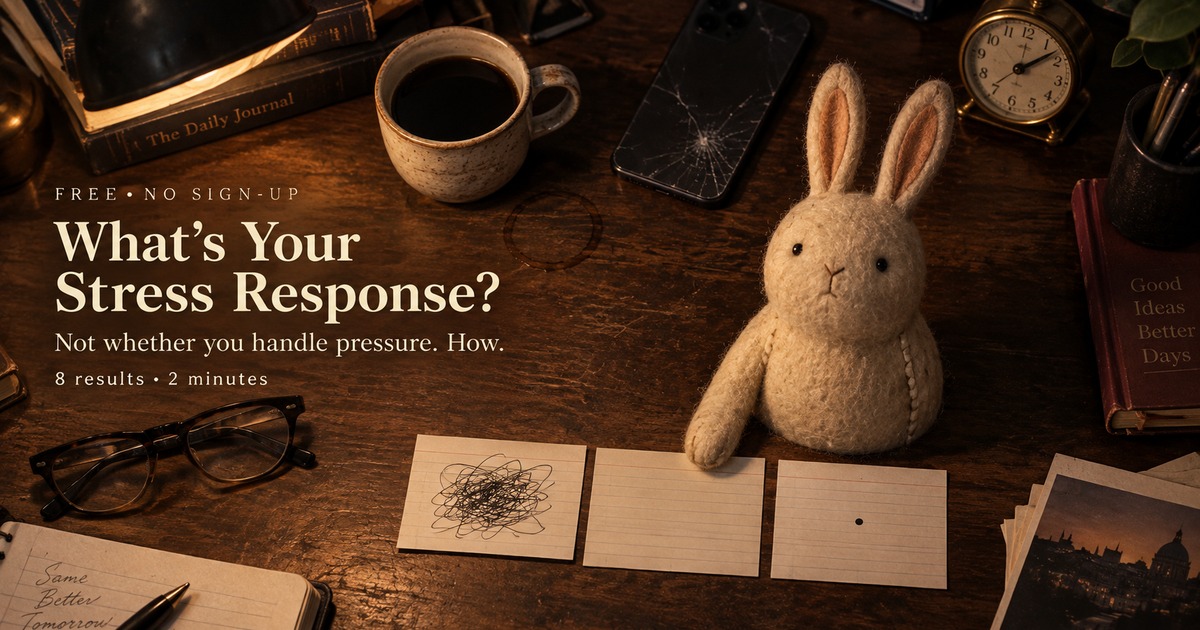
There's a default picture of a person under pressure. Short with people, visibly wound up, obviously not okay. Every piece of advice about noticing stress in yourself or anyone else is built on top of that picture.
It's accurate for maybe a third of people.
For everyone else, pressure does something quieter or slower, and the advice never lands because it's answering a question they don't have. Three things vary independently, and the combination is what makes one person's experience of a hard week unrecognizable to the next.
When it lands
Some people feel it in the first second. The sentence isn't even finished and their chest has already reported in. That's uncomfortable, but it has one enormous advantage: the reaction and the cause are attached to each other. They know what happened and they know when.
For others, absolutely nothing arrives at the time. They take the news, ask reasonable questions, get through the rest of the day, and then it turns up at eight in the evening while they're doing something completely unrelated.
Delayed people tend to be praised for handling things well, which is a strange thing to be praised for when the bill just hasn't arrived yet. They also tend to misfile it. Six hours of delay is long enough that when it finally lands, it lands on whoever happens to be nearby.
Whether it shows
This is the one that causes the most trouble, because it's invisible by definition.
Some people's faces report everything. Nobody has to ask, and nobody has to guess. There are real costs to that — your worst thirty seconds are public, and people read intensity as a verdict on them — but there is also a benefit that's easy to miss. Something that shows gets responded to.
Other people show nothing. Same voice, same expression, and a considerable amount happening underneath that never reaches the surface. In a hard meeting, this is genuinely valuable; rooms stay calm because one person's face stayed calm.
But it sets up a feedback loop that runs for years. You look like you have room, so you get given more. Nobody checks on you, because there's nothing to check on. And you never get to find out what would have happened if you'd said the plain version out loud, because you never have.
The gap between how it reads and how it feels doesn't close on its own. Somebody has to say something, and it's always going to be the person on the inside of it.
What brings you back
The third dial is recovery, and it's where most well-meaning offers of help go wrong.
Some people come down by discharging — moving, running, cleaning something, saying the entire thing out loud to one specific person. For them, being left alone with it is the worst available option. The energy has nowhere to go.
Others come down by powering off. An empty room, no conversation, phone face down. For them, company is a job. Being asked to explain the day is being asked to do the day again.
Both of these people are trying to help each other, and both of them are offering the thing they'd want. "Let me come over" and "I'll give you some space" are the same gesture aimed in opposite directions.
Why the map is worth having
None of this is about who handles pressure better. All eight combinations work, and all eight have a specific failure mode attached.
What the map is useful for is much narrower, and much more practical. It tells you what to ask for, which is the single thing most people never do — partly because they've never named it, and partly because they assume everyone recovers the way they do.
If it doesn't show on you, someone has to be told. If it lands late, the people at home deserve a warning that has nothing to do with them. If you come down by moving, the offer to sit quietly with you isn't the one to accept.
One caveat worth stating plainly: if the pressure never lets up, or the flatness is there on the quiet weeks too, that isn't a stress style and no quiz will sort it. That's worth saying out loud to someone.