The fifth letter type tests don't measure, and why it changes everything
Two people with identical four-letter types can feel like completely different people. The missing variable isn't a trait — it's how much of it reaches the outside.
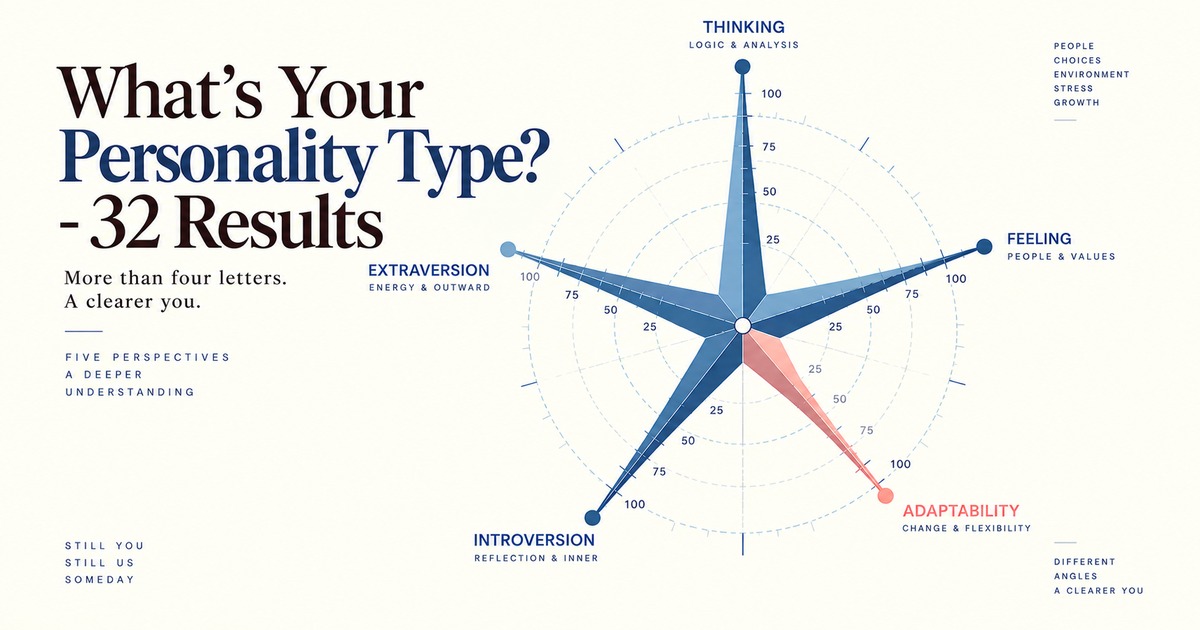
You've probably met two people with the same four-letter type who felt nothing alike.
Two INTJs where one reads as warm and invested and the other as a locked door. Two ENFPs where one is all fireworks and the other seems almost reserved until you get them onto the right subject.
Same four letters. Completely different to be around. The letters weren't wrong — they were just missing a dimension.
What the four letters actually describe
The standard type framework describes how you process, not how you present.
- E / I — where your energy comes back from
- S / N — what kind of information you trust
- T / F — what you weigh when deciding
- J / P — whether you'd rather close a decision or keep it open
All four are internal. They describe the machinery. None of them says anything about how much of the output is visible to the person sitting across from you, and that turns out to be most of what people experience when they meet you.
The fifth dimension: temperature
Call it temperature. How much of what you feel reaches your face and your voice.
It isn't extraversion — plenty of extraverts are unreadable and plenty of introverts are completely transparent. It isn't Feeling either; a T type can be visibly, obviously invested, and an F type can process enormous feeling behind a flat expression.
It's a separate dial, and it produces the two most common misreadings people live with:
Cool types get read as disapproving. A neutral expression is not neutral information — people fill the blank, and they fill it negatively. Cool ESTJs and ISTJs in particular spend years being experienced as disappointed by people they thought were doing fine.
Warm types get read as less rigorous. Conviction and reasoning arriving together tends to make people discount the reasoning. Warm INTJs and INTPs routinely get described as emotional about arguments they've thought through more carefully than anyone else in the room.
Neither of those is about competence. Both are about signal.
Sixteen types, thirty-two experiences
Adding one binary dimension doubles the resolution, and it's the doubling people actually notice in daily life. Whether someone is INFJ matters. Whether you can tell what an INFJ is thinking matters more for what it's like to work beside them.
It also explains why type descriptions so often feel half-right. Standard profiles are usually written for one temperature — often the warm version for F types and the cool version for T types — which leaves a lot of people reading their own type and thinking that's sort of me, but not the tone of it.
What to do with your temperature
Neither setting is better. Both have one specific, predictable cost:
If you run cool, people are guessing about you and guessing badly. The fix is small and repetitive: say the positive thing out loud, name where you stand, share the half-formed draft instead of only the finished conclusion. Not a personality change — a signal change.
If you run warm, the risk is that your intensity does the talking. Separate the two on purpose: present the reasoning first, the conviction second. Delivered together they cancel; delivered apart, both land.
One caveat worth stating
Type frameworks are useful language, not measurement. Four-letter typing is not a validated psychological instrument, the categories are fuzzy at the edges, and plenty of people sit near the middle of a dimension and flip depending on the year.
What they're genuinely good for is vocabulary — a way to describe a difference you'd already noticed but couldn't name. That's a real thing to get from a quiz, and it's a smaller claim than most type content makes.
The test below runs 25 questions across all five dimensions and returns one of 32 results, with your cognitive function stack and the specific misreading your temperature tends to produce.