The color people would pick for you isn't the one you'd pick
The viral "ask your friends what color you are" trend works because it measures three things you can't see about yourself — how warm you read, how fast you register, and how much you move.
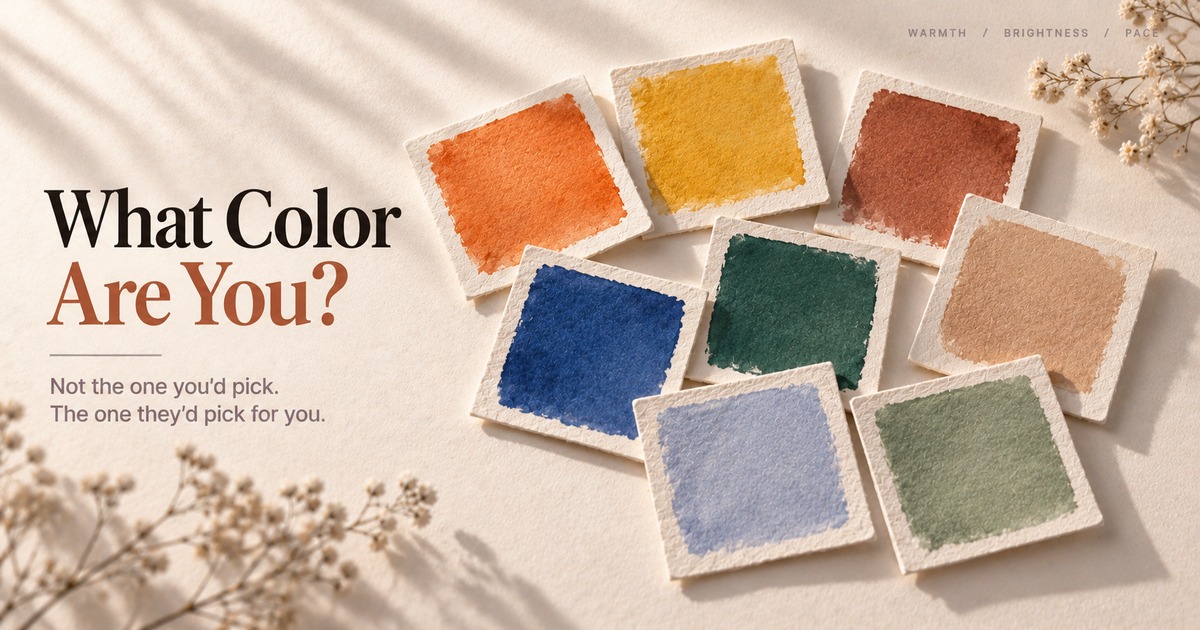
There's a reason the color question spread instead of dying like most quiz trends. It isn't a quiz at first — you ask your friends, and their answers are weirdly consistent with each other and weirdly different from what you would have said.
That gap is the whole thing. Your favorite color is a preference. The color people assign you is a summary of how you land in a room, and you are the only person in the world who can't observe it.
What people are actually encoding
When someone says "you're definitely a burnt orange," they aren't thinking about your wardrobe. They're compressing three separate readings into one word.
Warmth — do you move toward people, or do you let them come to you? This is the fastest read anyone makes and it's almost never wrong. Warm doesn't mean nicer; it means you close the gap yourself instead of waiting.
Brightness — how quickly do you register? Some people are formed as an impression in the first minute. Others take four or five meetings to come into focus and then never go out of it. Bright isn't better. It's just faster, and it comes with being harder to revise once someone's decided.
Motion — do you stay, or are you already elsewhere? This is the one people notice about you last and mention about you most.
Three dials, two settings each. Eight colors — and the reason a friend's answer feels uncannily specific is that they're reading all three at once without knowing they're doing it.
Why the reading is more accurate than yours
You experience yourself from the inside, in sequence, with all the context. Everyone else gets the outside, all at once, without any of it.
That makes them worse at knowing why you do things and considerably better at knowing what you're like to be around. A friend can't tell you what your restlessness is for. They can tell you that plans with you get made twice and happen once.
Neither view is the true one. But if you've only ever had the inside view, the outside one is the new information.
What the mismatch usually means
Two patterns come up constantly.
People who read as bright are often surprised, because they don't feel loud on the inside at all. Brightness isn't volume — it's contrast. You can be quiet and still be the first person someone would find in a group photo.
People who read as still are often the most surprised, because their inner life is anything but still. Motion here means what other people can see moving. A person full of racing thoughts who has held the same job, the same apartment and the same four friends for a decade reads as immovable, and to everyone but them, that's simply true.
Try it in both directions
Take the color quiz yourself, then ask two friends what color they'd pick for you before telling them your result. The interesting part isn't whether they match. It's which of the three dials they read differently — that's the one you've been misjudging about yourself.
If the warmth dial is the one that surprises you, the green flag quiz goes deeper into what you actually give people, and the toxic trait quiz runs the same instinct in the other direction.