Why you can't focus anymore — and why "just delete the apps" keeps failing
The attention problem most people describe isn't one problem. It's a reflex, a span, and a tolerance for delayed payoff, and they come apart in ways that explain why generic advice bounces off.
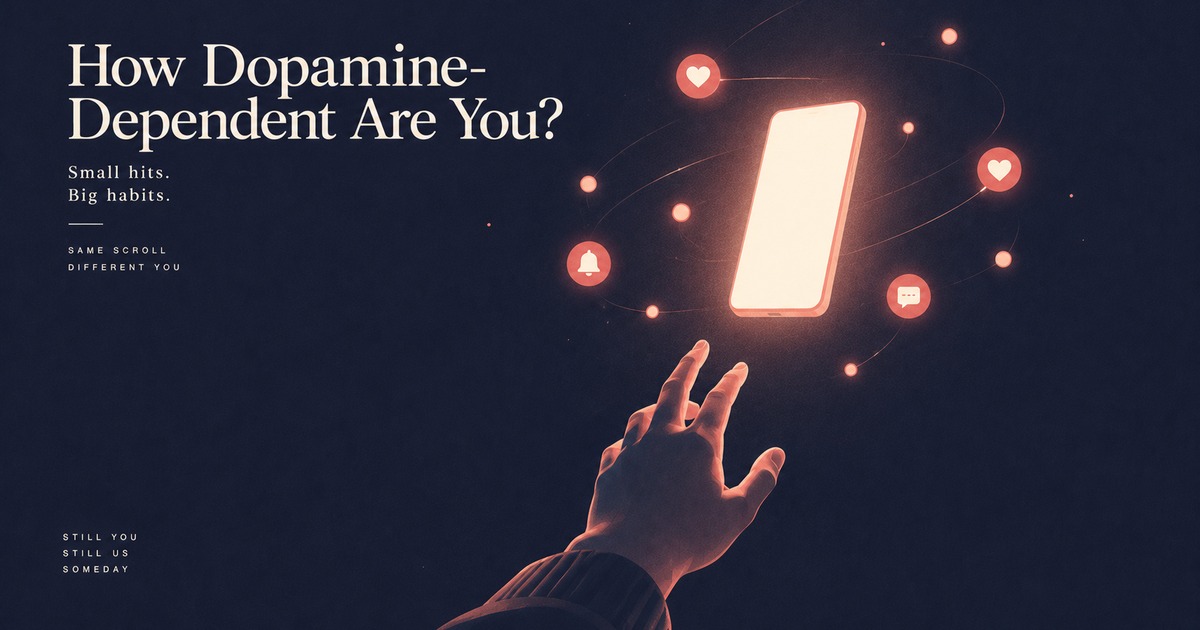
Almost everyone says the same sentence now: I can't focus like I used to.
And almost everyone gets the same advice. Delete the apps. Put the phone in another room. Try a timer. Most people try some version of this, it works for about nine days, and then things return to exactly where they were.
That failure rate is informative. It suggests the advice is aimed at the wrong thing.
Three things wearing one name
What people call an attention problem is usually a mix of three separate mechanisms.
The reflex. The phone is out before you decided to take it out. Elevator door closes, hand moves. This is not a choice you're losing — it's a motor pattern that fires in the gap before deliberation happens.
The span. How long you can stay with one thing before you need something else. A two-hour movie with no second screen. A long article, start to finish. This is a capacity, and it genuinely does shrink with disuse.
The payoff clock. How long you'll continue something with no visible reward. Three weeks into a project where nothing is working yet. Month two of a hobby you're still bad at.
These are independent. Plenty of people have an unbreakable reflex and a perfectly intact span — they grab the phone constantly and can still read for three hours once they start. Others never reach for anything and still can't stay with a slow project past week two.
That's why generic advice misses. "Delete the apps" targets the reflex, which is often not the thing that's actually costing you anything.
Which one is actually your problem
Quick diagnostic.
If you lose the whole evening to something you never decided to do — surfacing forty minutes later, somewhere unrelated — that's the reflex. Friction fixes work here, and only here. Phone in another room, app off the home screen, grayscale. These are cheap and they do work, provided you're aiming them at the right target.
If you can start things but not stay — you sit down to watch the movie and you're on your phone by minute twenty, every time — that's the span, and friction won't fix it. Span responds to practice and to nothing else. Something with a beginning and an end, done all the way through, several times a week. It rebuilds faster than people expect, but it can't be deleted into existence.
If you start a lot of things and finish very few — four hobbies begun, none continued past the bad stage — that's the payoff clock, and it isn't about phones at all. Removing distractions does nothing, because the problem isn't that you got pulled away. It's that nothing was pulling you forward.
The fix there is artificial short-term feedback: a visible streak, a log, one other person who asks. Not motivation — just evidence that something is happening during the stretch where nothing appears to be.
The part that's actually new
It's fashionable to say attention spans are collapsing and also fashionable to say that's moral panic. The more defensible version is narrower.
What genuinely changed is the availability of a reliable alternative. Boredom used to resolve into something — a thought, a plan, noticing the room. Now there is always a better-than-boredom option within arm's reach, at zero cost, every single time. It isn't that your capacity was destroyed. It's that the conditions that used to exercise it don't occur anymore unless you create them on purpose.
Which is why the nine-day failure pattern makes sense. Deleting an app removes the option without replacing the condition. Within a week another option arrives, and you're back.
What to do with this
Pick the mechanism, then the tool.
- Reflex → friction. Distance, not willpower. This is the one where deleting things works.
- Span → reps. One thing with an ending, all the way through, repeatedly. Boring and effective.
- Payoff clock → visible short-term evidence during the invisible stretch.
And one thing that helps all three: deliberately keep some of the boredom. Nine floors in an elevator, the three minutes waiting for water to boil. Not as discipline — as the only remaining place where the capacity gets used at all.
Worth saying
Sustained difficulty concentrating isn't always a habit problem. ADHD, depression, poor sleep, and burnout all produce exactly this and none of them respond to friction tricks or a better timer. If this has been true for years, costs you a lot, or arrived alongside other changes, that's a conversation with someone qualified rather than a productivity problem to solve alone.
For the ordinary version — the one that showed up in the last few years and tracks suspiciously well with your screen time — it's rarely a single broken thing. It's three dials, and the advice that failed you was probably aimed at the wrong one.