Why you keep attracting the same person (you don't — you keep selecting them)
The pattern people call bad luck in dating is usually a filter running quietly in the first ten minutes. Here's what that filter is actually screening for, and why the answer is rarely what you'd say out loud.
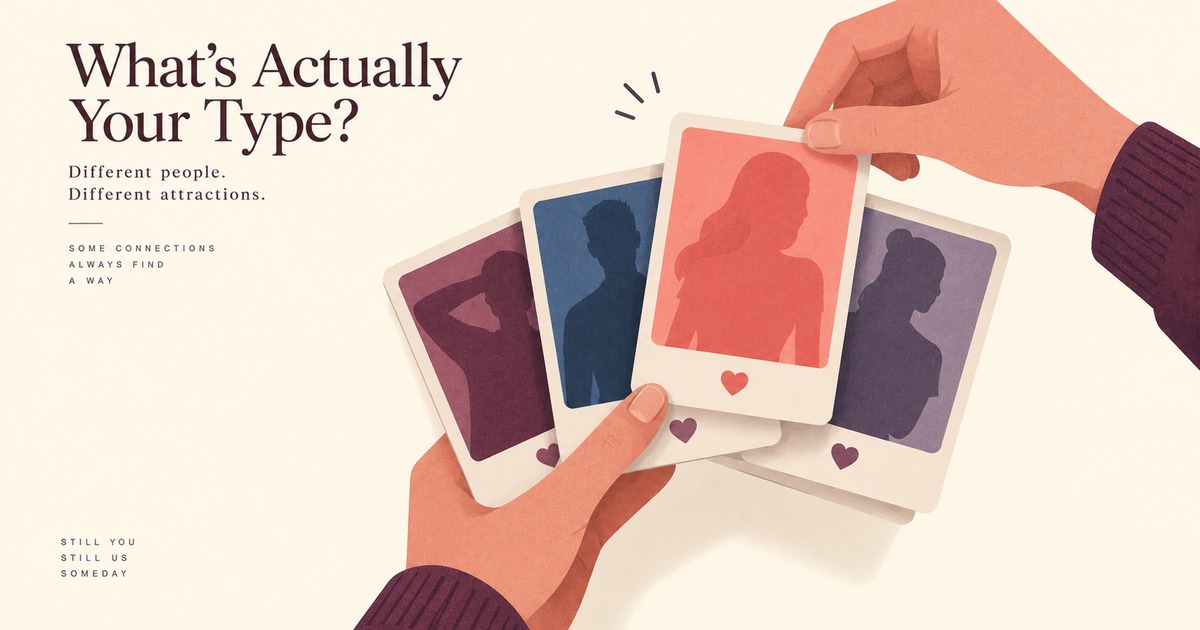
"I always attract the same kind of person."
It's one of the most common sentences in dating, and the grammar is doing a lot of work. Attract puts the mechanism outside you — like a frequency you're broadcasting, or a sign on your back only certain people can read.
The less flattering version is that attraction isn't the step where the pattern happens. Selection is.
The filter runs before you notice
Plenty of people cross your path. Most of them you register and forget within a minute. A small number produce something — interest, curiosity, a slight increase in attention — and that sorting happens fast, well before you've learned anything that would justify it.
So when the same character keeps appearing across years and cities and apps, the useful question isn't why they keep finding you. It's what got sorted into the yes pile in the first ten minutes, and on what basis.
What the filter is usually screening for
Almost never the thing you'd list.
Ask someone their type and you'll get traits: funny, driven, kind, tall, reads. Watch their actual history and you'll usually find something structural instead — a familiar dynamic rather than a familiar description.
Some common ones:
Effort you can feel. Some people are drawn to being pursued, some to pursuing. Neither is a trait of the other person; it's a shape of the interaction. If you light up when someone is hard to reach, that's a filter, and it's not selecting for quality.
A specific temperature. Warm and demonstrative, or cool and self-contained. People often find one of these legible and the other unreadable, then describe the unreadable one as boring.
Something to solve. This one is uncomfortable. If competence and steadiness read to you as flat, and a little chaos reads as depth, you'll end up with a pattern that looks like terrible luck and is actually a preference.
Familiar communication. Not healthy communication — familiar. Whatever the emotional language of your early life was, you can read it fluently, and fluency feels like connection.
Why chemistry can't help you here
Chemistry is often just recognition. Something in the shape of this person maps onto something you already know, and your nervous system reads the match as significance.
That's why the most promising first dates so often produce the most repetitive outcomes, and why the person everyone agrees is great for you can feel like nothing at all. Nothing is being detected. There's just nothing to recognize.
The point isn't that chemistry is fake. It's that it's evidence of familiarity, not of fit, and those are different claims.
What to do about it
Not "date people you're not attracted to." That advice is both unpleasant and useless.
Try this instead.
Name the shape, not the traits. Write down your last four. Skip what they looked like and what they did. Write what the dynamic was — who reached more, how fast it moved, who was managing whom. The repeated item will be obvious and it will not be a personality trait.
Check what you call boring. Boring is where the pattern hides. If steady, available and clear feels flat to you, you've found the filter.
Give it four dates. Recognition happens in minutes. The absence of recognition is not the same as the absence of potential, and four dates is roughly where actual information starts arriving.
The reframe worth keeping
A pattern that runs outside your awareness feels like fate. A pattern you can describe in one sentence is just a preference, and preferences are editable.
You're not attracting anybody. You're choosing, quickly, with criteria you never wrote down. The whole job is getting the criteria written down.